The 1755 Lisbon Earthquake: When the Sea Pulled Back Before the Wave
On 1 November 1755 a great earthquake struck off Portugal, the sea withdrew from Lisbon's harbour, and a tsunami returned to drown a city already shaking and burning.
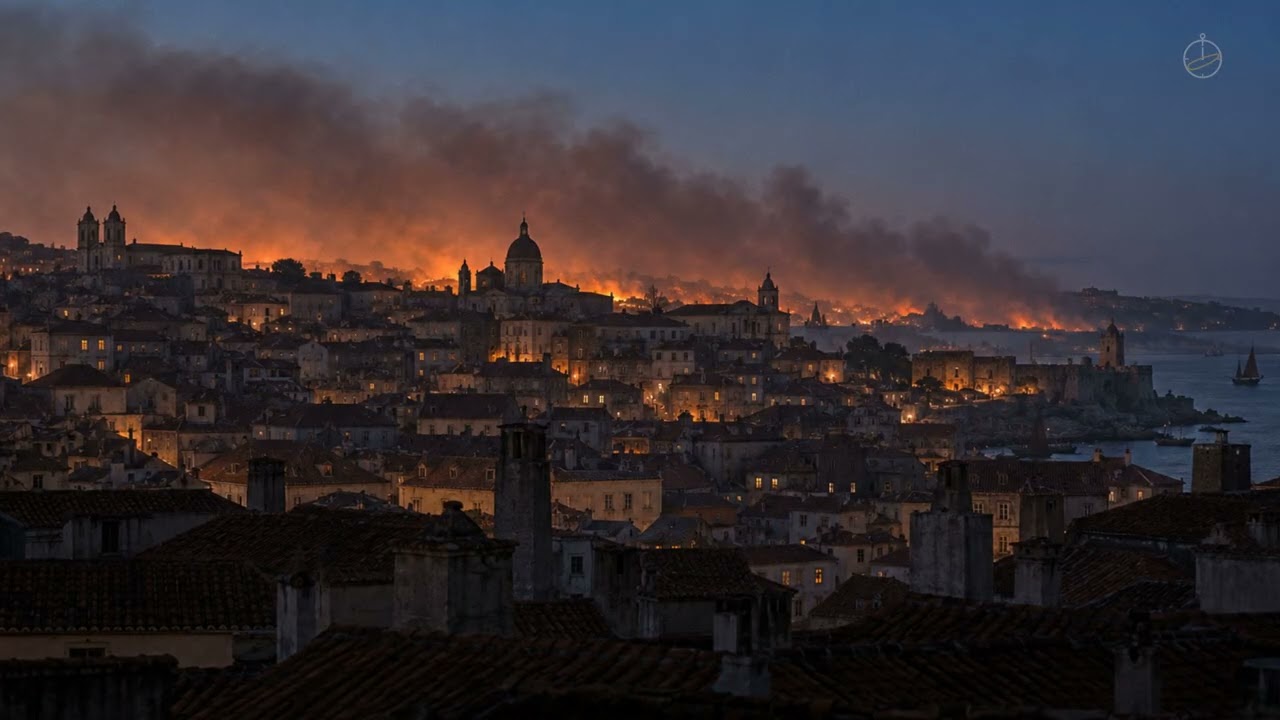
On the morning of 1 November 1755, a great earthquake struck beneath the Atlantic southwest of Portugal — and the people who walked onto the exposed seabed as the harbour emptied did not know they had minutes to live.
The shaking came first, then the sea pulled back, then a tsunami returned and fires burned for days. The Lisbon disaster killed tens of thousands and changed how Europe thought about nature, faith and the earth itself.
What happened
At about 09:40 on All Saints’ Day, as churches were full, a magnitude ~8.5–9.0 earthquake ruptured offshore along the boundary between the African and Eurasian plates. Three or four minutes of violent shaking collapsed much of Lisbon. Survivors fled to the open space of the waterfront — where they watched the water in the Tagus estuary drain away, exposing lost cargo and old shipwrecks.
Minutes later the sea came back as a series of tsunami waves, several metres high, sweeping across the harbour and low city. Fires started by overturned cooking flames and candles then merged into a firestorm that burned for days. Estimates of the dead in Lisbon range from 12,000 to 50,000, with many thousands more along the coasts of Portugal, Spain and Morocco.
The science: why the sea retreats first
When a tsunami’s leading edge is a trough rather than a crest, the shoreline drains before the wave arrives. That sudden, dramatic withdrawal of the sea is nature’s clearest tsunami warning — but only for those who know to run from it. The water does not always pull back first, which is why any strong or long coastal shaking is itself the signal to move to high ground.
A disaster that changed Europe
Portugal’s chief minister, the Marquis of Pombal, organised relief with the famous order to “bury the dead and feed the living,” then rebuilt Lisbon on an early earthquake-resistant grid using the gaiola timber cage. He also circulated a survey of what people had felt across the country — an early step toward the science of seismology. Philosophically, the catastrophe shook Enlightenment optimism, provoking Voltaire’s Candide and Kant’s early writings on earthquakes.
What if it happened today?
A comparable rupture now would threaten millions along the Atlantic coasts of Iberia and North Africa, with tsunami waves reaching Lisbon in well under an hour. Modern seismic networks and tsunami warnings help — but the oldest rule still saves lives: if you are on a coast and feel strong or long shaking, or see the sea suddenly pull back, move inland or to high ground and do not wait for an official alert.
Key facts
- Date
- 1 November 1755, ~09:40 local time
- Estimated magnitude
- ~8.5–9.0
- Chain of events
- earthquake → sea withdrawal → tsunami → multi-day fires
- Deaths
- tens of thousands in Lisbon alone
- Legacy
- early seismology and earthquake-resistant rebuilding
Frequently asked questions
Why did the water disappear from the harbour?
The tsunami arrived trough-first, so the sea drained away before the crest returned as a destructive wave.
Is a withdrawing sea always a tsunami sign?
A sudden retreat is a strong warning, but tsunamis do not always pull the water back first. Treat strong or long coastal shaking as the signal to evacuate.
Related stories: The Great Smog of London, 1952 · The Scilly naval disaster, 1707
Sources & further reading
- Encyclopaedia Britannica — Lisbon earthquake of 1755
- USGS — Tsunamis and how they form
- NOAA — Tsunami safety
- U.S. Tsunami Warning — natural warning signs
The companion video uses AI-generated reconstructions, not archival footage; any single on-screen character is illustrative. The historical details above are drawn from the sources listed.
Watch the 40-second version
Keep reading
-
The Thames Frost Fair of 1684: When London Held a Market on a Frozen River
In the winter of 1683–84 the River Thames froze solid for two months and Londoners built a fair on the ice — with a printing press and an ox roast. Here's why it froze then, and can't now.
-
Göbekli Tepe: The 11,600-Year-Old Monument Older Than Stonehenge and the Pyramids
Around 9600 BC, hunter-gatherers in what is now Türkiye raised massive carved stone pillars at Göbekli Tepe — thousands of years before farming, writing, Stonehenge or the pyramids.
-
Krakatoa, 1883: The Explosion Heard 4,800 km Away
The 1883 eruption of Krakatoa produced what may be the loudest sound in recorded history — heard nearly 4,800 km away — and tsunamis that killed about 36,000 people.
Comments
Spotted an error? Have a question?