The Year Without a Summer: How Tambora’s 1815 Eruption Froze 1816
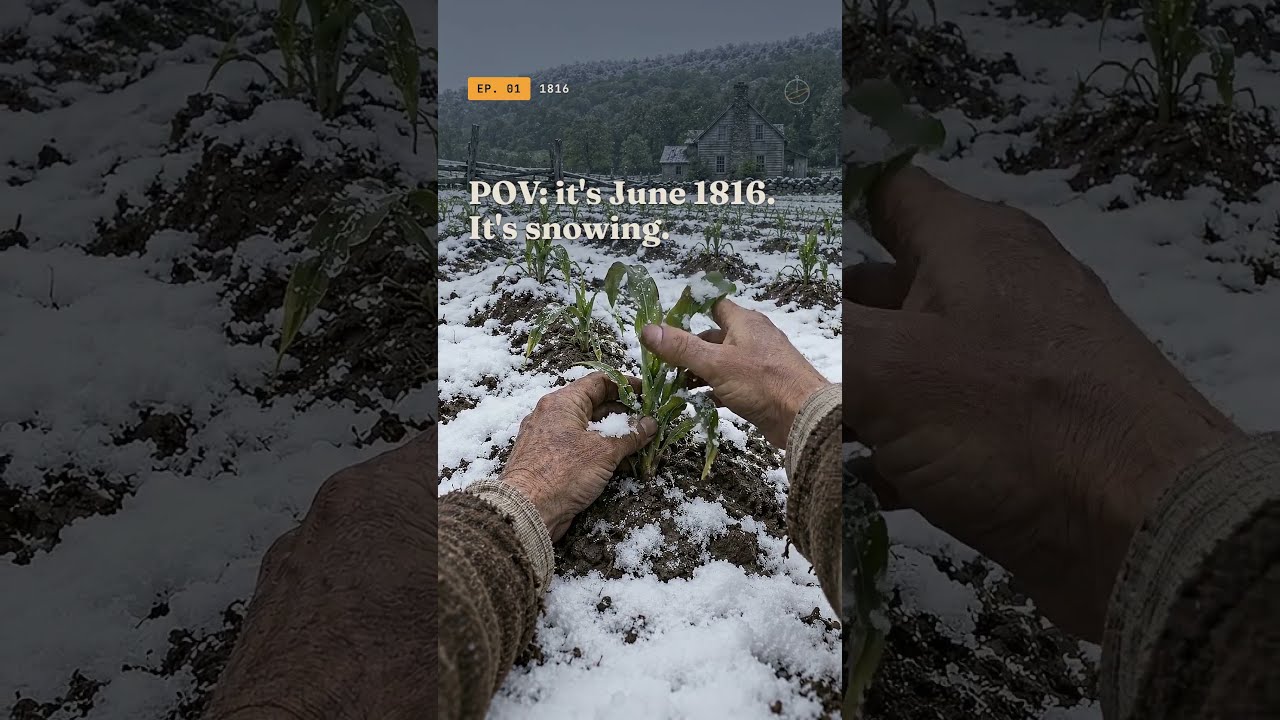
In April 1815, Mount Tambora in Indonesia produced the largest volcanic eruption in recorded history — and a year later the Northern Hemisphere skipped summer.
The eruption injected so much sulfur into the stratosphere that 1816 became known as the Year Without a Summer: snow fell in June in New England, frost killed crops through the growing season, and famine spread across Europe.
What happened
Mount Tambora, on the island of Sumbawa, had been dormant for centuries. Its climactic explosion on 10–11 April 1815 rated VEI 7 on the Volcanic Explosivity Index — the most powerful eruption in at least 1,300 years. The blast and the pyroclastic flows, tsunamis and famine that followed killed an estimated 70,000 people in the region, making it one of the deadliest eruptions ever recorded.
But Tambora’s deadliest legacy travelled around the planet. Millions of tonnes of sulfur dioxide reached the stratosphere, where it formed a veil of sulfate aerosols that reflected sunlight back to space.
The science: how a volcano cools the planet
Volcanic ash falls out of the sky within days. Sulfur gases are different. In the stratosphere they convert to tiny sulfuric-acid droplets that linger for a year or more, dimming the sun worldwide. Average Northern Hemisphere temperatures fell by roughly 0.4–0.7 °C in 1816 — small on paper, but enough to shorten growing seasons past the point where crops ripen.
A summer that never came
In 1816, late frosts and cold rain wrecked harvests from New England to Ireland. Food prices soared, triggering the last great subsistence crisis of the Western world. The gloom had a cultural footprint too: trapped indoors by a cold, wet Lake Geneva summer, Mary Shelley began writing Frankenstein, and the dim skies colour the paintings of the era.
What if Tambora erupted today?
A VEI-7 eruption now would disrupt aviation, agriculture and supply chains far more than in 1815, because the modern food system runs on thin margins and long shipping routes. Climate scientists study Tambora precisely because it is the best natural experiment we have for sudden global cooling — and a sobering reminder of how exposed a connected world is to a single geological event.
Aftermath and legacy
The crisis of 1816 pushed waves of migration, spurred early work on weather records, and remains the benchmark event for “volcanic winter.” Ice cores from Greenland and Antarctica still carry Tambora’s sulfur spike, letting scientists date and measure the eruption two centuries later.
Key facts
- Volcano
- Tambora, Sumbawa, Indonesia
- Climax
- 10–11 April 1815 (VEI 7)
- Regional deaths
- ~70,000
- Global effect
- the 1816 “Year Without a Summer”
- Cultural echo
- inspired Mary Shelley’s Frankenstein
Frequently asked questions
Why did the summer of 1816 fail?
Sulfate aerosols from Tambora’s 1815 eruption spread through the stratosphere and reflected sunlight, cooling the Northern Hemisphere enough to cause widespread crop failures.
Was Tambora bigger than Krakatoa?
Yes. Tambora (VEI 7) released several times more material than Krakatoa’s 1883 eruption (VEI 6).
Related stories: Krakatoa, 1883 · 536 AD: the worst year to be alive
Sources & further reading
- Smithsonian Global Volcanism Program — Tambora
- Encyclopaedia Britannica — Mount Tambora
- USGS — Volcanic gases and climate
The companion video uses AI-generated reconstructions, not archival footage; any single on-screen character is illustrative. The historical details above are drawn from the sources listed.
Keep reading
-
The Thames Frost Fair of 1684: When London Held a Market on a Frozen River
In the winter of 1683–84 the River Thames froze solid for two months and Londoners built a fair on the ice — with a printing press and an ox roast. Here's why it froze then, and can't now.
-
Göbekli Tepe: The 11,600-Year-Old Monument Older Than Stonehenge and the Pyramids
Around 9600 BC, hunter-gatherers in what is now Türkiye raised massive carved stone pillars at Göbekli Tepe — thousands of years before farming, writing, Stonehenge or the pyramids.
-
Pompeii, 79 AD: 18 Hours Inside the Eruption of Vesuvius
When Vesuvius erupted in 79 AD, Pompeii had roughly 18 hours of warning falling from the sky before the pyroclastic surges arrived. Most who stayed did not survive them.
Comments
Spotted an error? Have a question?